
The End of Jobs? How to Create Work and Generate Income
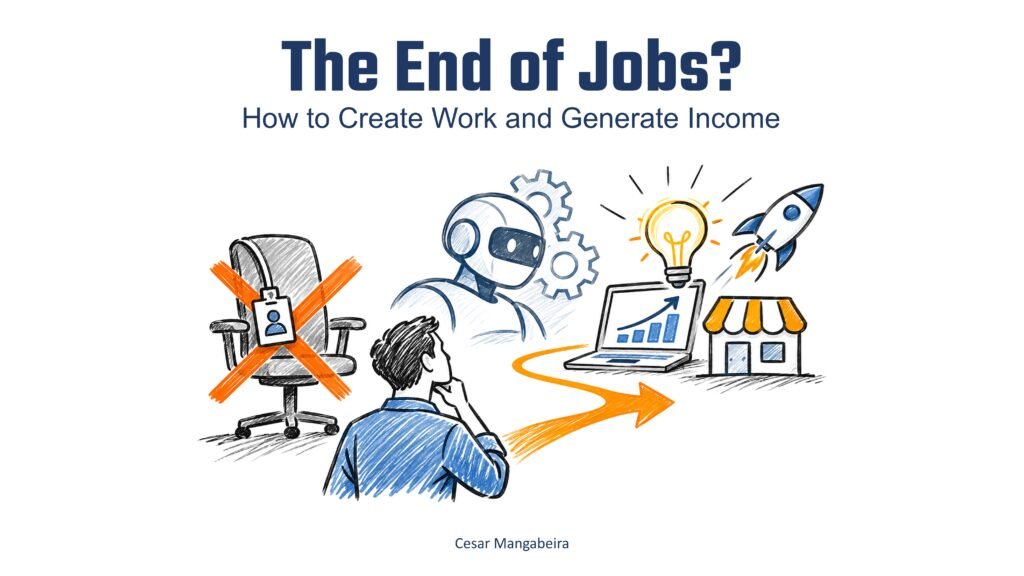

The End of Jobs? How to Create Work and Generate Income
Imagine an economy in which companies can produce, sell, manage their operations, and make decisions using artificial intelligence and robotics, with increasingly limited human involvement.
As this possibility draws closer, an important question emerges: if organizations need fewer people to carry out their activities, how will individuals continue to generate income?
For generations, the answer has followed a familiar path: study, earn a degree, get a job, and build a career. Employment has become the primary means of economic participation for most people.
Artificial intelligence could profoundly change this model. As machines and systems take over intellectual, creative, decision-making, and physical activities, the number of available jobs could decline across different fields.
Faced with this scenario, we will need to rethink the very concept of work. After all, employment is a professional relationship between an individual and an organization, while work encompasses any activity capable of producing goods, services, or economic value.
How can people build their professional lives in an economy where finding a job may no longer be an option for a large part of the population?
- Employment May No Longer Be the Primary Path
Automation could reduce the need to hire people for activities that currently depend on human workers.
Companies may operate with smaller human teams, autonomous systems, and robots. Intellectual and physical tasks could increasingly be performed at scale through these technologies.
In this scenario, relying exclusively on finding a job will represent a risk for anyone who needs to generate income.
This transformation will require a new way of thinking about professional life, with greater emphasis on creating opportunities independently.
- Work Goes Far Beyond Employment
If organizations need fewer workers, individuals will have to consider other ways of participating in the economy.
Work may take many different forms:
- Creating products based on original ideas.
- Developing services that address market needs.
- Building businesses with the support of artificial intelligence.
- Working as independent professionals.
- Identifying commercial opportunities and turning knowledge into products or services.
Technology may allow individuals to develop projects and operations that previously required entire teams.
- Universities Need to Reinvent Their Role
The transformation of the economy raises a direct challenge for universities.
For decades, higher education has focused on knowledge transfer, specialization, and preparation for the job market.
In the new economy, knowledge will be widely accessible, and artificial intelligence may perform complex intellectual activities.
So, what will the role of the university be?
Perhaps the answer lies in a shift in priorities: educating people who can turn knowledge into real-world results.
The new environment may demand hands-on professionals capable of identifying problems, developing projects, testing solutions, building products, and starting businesses.
Universities will need to bring education closer to practical experience, encourage business creation, and prepare students to participate in an economy where generating income may depend on individual initiative.
The university of the future should prepare people to create opportunities rather than focus exclusively on preparing candidates for jobs.
- A New Mindset for Generating Income
This transformation also requires a change in how individuals plan their professional lives.
The traditional question is: “Where can I find a job?”
A new question needs to take its place: “What can I create, offer, or sell to generate my own income?”
This shift involves initiative, the ability to identify opportunities, and the willingness to put ideas into practice.
Artificial intelligence may serve as a productive resource, allowing individual entrepreneurs to develop activities, create solutions, and reach customers.
The challenge will be learning how to use technology to turn ideas into economic activities.
Conclusion
The economy may undergo a transformation in which companies need fewer and fewer workers to carry out their activities.
In this scenario, employment may lose its position as the primary reference point in professional life. The ability to create, start businesses, and generate income independently will become increasingly important.
This change will also reach universities, which will need to rethink their educational models and prepare people for a reality in which knowing how to do things, experiment, and build may become highly valuable.
Prepare to stop looking for someone to hire you. Start thinking about what you can create, offer, and sell.
Questions for Discussion
- If companies offer fewer and fewer jobs, what will be the main way for people to generate income?
- How can people create their own work and income opportunities in an economy dominated by AI and robotics?