S&OP maturity: Continuous evolution

S&OP maturity: Continuous evolution
How can you tell whether a company truly has a mature S&OP process?
Having meetings, forecasts, and performance indicators does not, by itself, mean that the process has reached an advanced stage. S&OP maturity is related to how the organization plans, integrates functions, and uses the process to make decisions. Maturity models are used precisely to identify the current stage and guide the evolution of the process. (Periodikos)
In the book S&OP Management, I present a structure with five levels:
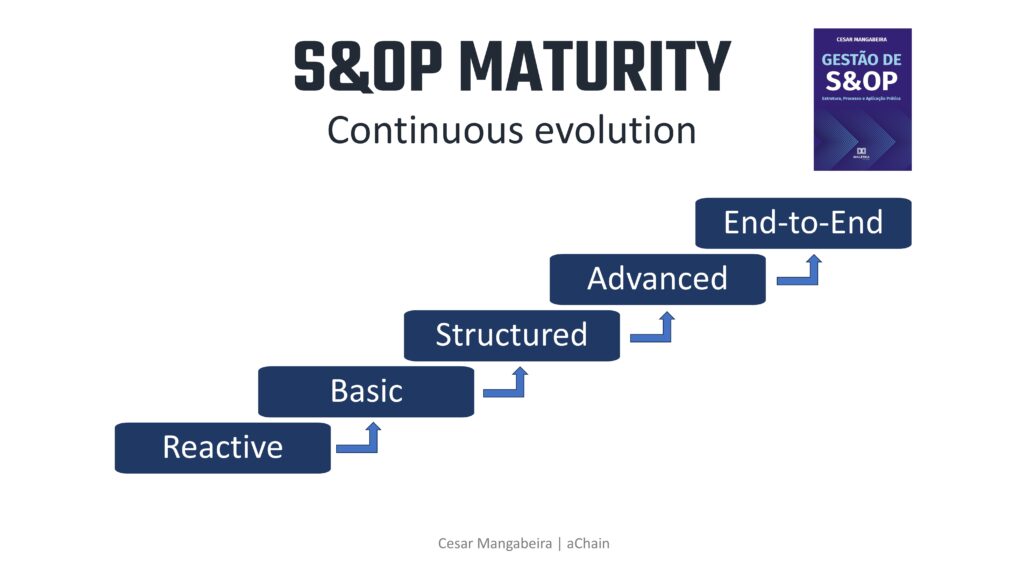
Reactive → Basic → Structured → Advanced → End-to-End
🤝 Sponsored post: https://www.achain.com.br/
Take the free assessment at: https://www.achain.com.br/sop-maturity-assessment/
Each level represents a change in how S&OP is understood and used within the organization.
- Level 1: Reactive
At the first level, the organization operates in silos.
Each area focuses its decisions on its own needs, with little connection to other functions. Problems are addressed as they arise, and planning has little influence on business management.
- Silo behavior
- Lack of structured planning
- Lack of forecasting
- Disconnected objectives and metrics
- Focus on the past
- Decisions focused on immediate problems
- Low integration between demand, supply, and finance
At this stage, S&OP still lacks a formal structure. The company reacts to events and has difficulty anticipating future needs.
- Level 2: Basic
At the second level, S&OP begins to take shape.
The company recognizes the need to connect demand and supply and creates an initial planning structure. Meetings, metrics, and processes begin to be established.
The main focus is on balancing demand and supply.
- S&OP initiation
• Focus on demand and supply balancing
• Initial planning meetings
• Initial definition of metrics
• Planning processes begin to be documented
• Communication between areas remains fragmented
• Process gaps
• Demand and supply forecasting is still poorly integrated
There is progress compared with the reactive level, although S&OP is still under development. Areas begin sharing information, while each function still maintains part of its own planning practices.
- Level 3: Structured
At the third level, S&OP is implemented.
The process becomes part of the organization’s routine. The people involved know S&OP, understand its purpose, and participate in the defined meetings and activities.
Demand, supply, and finance begin working from a shared view.
- S&OP implemented
• Everyone knows and understands S&OP
• Demand, supply, and finance teams
• Regular and structured meetings
• Decisions based on data and projections
• Objectives and metrics connected to the business
• S&OP drives decision-making
Here, an important change takes place: S&OP moves beyond being a planning process and begins to drive decisions.
The organization starts using S&OP to evaluate alternatives, understand impacts across areas, and build a shared view of the business.
- Level 4: Advanced
At the fourth level, S&OP becomes part of the organizational culture.
Participation is no longer concentrated in the areas traditionally involved in the process. S&OP begins to involve all areas of the company and establishes a direct connection with business processes and strategy.
- S&OP culture
• S&OP involving all areas of the company
• Fully aligned with business processes and strategy
• Planning horizon beyond 12 months
• Connection between planning and strategy
• Scenario evaluation
• Decisions guided by long-term planning
The planning horizon expands. The organization begins discussing the future of the business within S&OP, connecting operational, tactical, and strategic decisions.
At this level, S&OP becomes part of business management.
- Level 5: End-to-End
At the fifth level, S&OP extends beyond the boundaries of the organization itself.
The focus becomes the supply chain as a whole.
Customers, suppliers, and partners become part of the integration, allowing planning to consider information and impacts that exist outside the company’s boundaries.
- S&OP with customers, suppliers, and partners
• Focus on the supply chain
• External integration
• Information sharing among participants
• Joint planning
• Assessment of impacts across the chain
• Anticipation of market changes
• Simulations and scenario analysis
End-to-End S&OP expands the planning perspective. The company begins to view the supply chain as a connected system, in which decisions made at one point can produce impacts across multiple other participants.
The evolution across the five levels
The journey can be summarized in five movements:
Level 1 | Reactive
Silos → lack of planning → focus on the past
Level 2 | Basic
S&OP initiation → demand + supply → planning organization
Level 3 | Structured
S&OP implemented → demand + supply + finance → integrated decisions
Level 4 | Advanced
S&OP culture → all areas → strategy → planning horizon beyond 12 months
Level 5 | End-to-End
Company → customers → suppliers → partners → supply chain
The evolution, therefore, is not related solely to the existence of a monthly meeting.
It involves a transformation in the way the company plans, integrates information, and makes decisions.
How can you identify your company’s level?
Would you like to know your company’s S&OP maturity level?
The assessment contains 50 questions distributed across the five maturity levels. Each level represents a set of characteristics that need to be present within the organization.
A company at Level 1: Reactive shows isolated decisions, silo-based operations, limited planning structure, and a focus on immediate problems.
At Level 2: Basic, S&OP begins to be structured through meetings, planning, and efforts to balance demand and supply.
At Level 3: Structured, S&OP is implemented, with demand, supply, and finance participating and the process being used to guide decisions.
At Level 4: Advanced, S&OP becomes part of the organizational culture, involves all areas, and connects with strategy and long-term planning.
At Level 5: End-to-End, planning reaches the supply chain, involving customers, suppliers, and partners.
The result should consider the highest level at which all requirements have been met. A company may therefore display characteristics of higher levels and still be classified at an earlier level when a requirement of that stage has not yet been met.
Take the assessment and discover your company’s current S&OP maturity level.
The central point
A company can conduct S&OP meetings and still be at an early maturity stage.
It can have forecasting, indicators, dashboards, and technological systems while continuing to make fragmented decisions.
The relevant question is:
How much does S&OP actually influence the organization’s decisions?
As maturity increases, the connection among planning, functional areas, strategy, and the supply chain tends to increase as well.
Conclusion
The five maturity levels show a journey:
Reactive → Basic → Structured → Advanced → End-to-End
The first stage is associated with reaction and silos.
The second begins the organization of S&OP.
The third consolidates the process and connects demand, supply, and finance.
The fourth incorporates S&OP into the organization’s culture and strategy.
The fifth expands planning across the entire supply chain.
The objective of the assessment is to discover where the company is today and what its next move should be.
🤝 Sponsored post: https://www.achain.com.br/
Take the free assessment at: https://www.achain.com.br/sop-maturity-assessment/
📚 eBooks list: https://www.cesarmangabeira.com.br/livros-cm/
Collaborative Forecasting, Demand Review Meeting Management, Procurement, Semiconductors, and more. Available on Google Play Books and major digital bookstores. Published in Portuguese, English, and Spanish.
Comments and sharing
What is your company’s S&OP maturity level: Reactive, Basic, Structured, Advanced, or End-to-End?
Which transition requires the greatest organizational transformation: reaching Structured S&OP or taking the process to End-to-End integration?