S&OP DEPLOYMENT: Shelve or Execute?

S&OP DEPLOYMENT: Shelve or Execute?
The S&OP Decision Meeting concludes the analysis, alignment, and decision-making stage. Once the plan is approved, a new stage begins: transforming the decisions made into an official reference for the entire company.
The S&OP publication process brings together the activities required to consolidate, validate, formalize, record, communicate, and deploy the approved plan.
The objective is to ensure that each area knows which plan to use, which decisions were made, which actions need to be executed, who is responsible, and which deadlines must be met.
- Publication begins after the Decision Meeting
The Decision Meeting approves the S&OP Plan. From this point forward, the decisions need to move from proposals to the company’s official plan.
The S&OP Owner brings together the approved decisions and initiates the publication process.
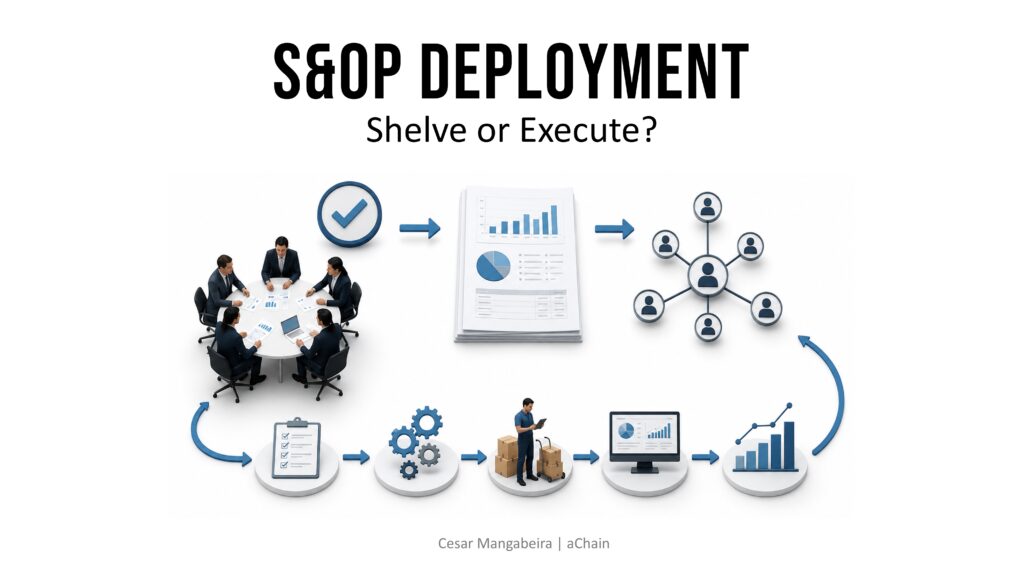
The flow can be represented as follows:
Decision Meeting → Approved S&OP Plan → Consolidate Decisions → Validate Plan → Record Official Version → Update Systems → Communicate to Areas → Deploy Responsibilities → Execute Actions → S&OE Monitors
Publication therefore creates the link between executive decision-making and execution by the areas.
- Consolidate the decisions
The first step is to bring all approved decisions together into a single version of the S&OP Plan.
Volumes, dates, inventories, capacity, scenarios, resources, financial decisions, and other definitions should be consolidated.
The S&OP Owner verifies that all decisions made during the meeting are represented in the plan.
The result of this stage is a consolidated version that will be submitted for validation.
- Validate the plan
The consolidated version needs to be checked before publication.
Validation should verify:
- Approved volumes
- Dates and periods
- Projected inventories
- Capacity
- Constraints
- Approved scenarios
- Financial impacts
- Action owners
- Decisions recorded in the meeting minutes
The main question is:
Does the plan to be published exactly reflect what was defined in the S&OP Decision Meeting?
- Formalize the official version
After validation, the plan receives an official identification.
The following should be recorded:
- S&OP Plan version
- Publication date
- Validity period
- Approved decisions
- Decision Meeting minutes
- Approval owners
Version control makes it possible to identify which plan represents the current decision.
Subsequent changes should follow the governance rules established by the company.
- Update the official systems
The published S&OP Plan needs to be reflected in the systems used by the company.
Depending on the organization’s structure, the update may involve an ERP, planning system, Supply Chain tools, demand systems, or other platforms.
The objective is to ensure that the systems used by the areas reflect the approved plan.
Publication therefore moves beyond a document and becomes part of the information used in execution.
- Communicate the plan to the areas
After publication, the plan needs to reach the areas responsible for execution.
The communication should provide:
- Current plan
- Main decisions
- Volumes
- Dates
- Responsibilities
- Deadlines
- Required actions
- Points requiring attention
Sales, Marketing, Production, Procurement, Logistics, Supply Chain, Finance, and other areas may receive different responsibilities.
Each area needs to understand how the plan affects its activities.
- Translate the plan into actions
Publication gains its practical meaning when decisions are transformed into actions.
For example, a decision to increase production can generate different responsibilities:
Approved S&OP Plan
↓
Increase production by 1,500 units
↓
Production → schedule manufacturing
Procurement → secure materials
Logistics → reserve transportation
Finance → monitor financial impact
Sales → align customer fulfillment
S&OP Owner → monitor execution
Each action should have an owner and a deadline.
A simple way to record the deployment is:
Action = What needs to be done; Owner = Who will do it; Deadline = When; Result = What must be delivered
- Start execution
With the plan published and responsibilities assigned, the areas begin execution.
From this point forward, the S&OP Plan becomes the reference used to guide activities related to the approved decisions.
When deviations occur, the areas should record the issue and follow the established rules for resolution and escalation.
- The role of S&OE after publication
S&OE monitors execution of the published plan in the short term.
The objective is to identify deviations between what was planned and what is happening in the operation.
Published S&OP Plan → Execution → S&OE Monitoring → Deviation Identification → Issue Resolution → Escalation When Required
S&OE therefore operates after S&OP publication, monitoring execution and addressing deviations according to the rules established by the company.
Solutions to the problem
The publication process can be structured into eight stages:
Decision → Consolidation → Validation → Formalization → Publication → Communication → Deployment → Execution and S&OE
Governance should define who consolidates, who validates, who approves, who publishes, who communicates, and who monitors the actions.
There should also be rules for version control and changes made after the plan has been published.
The central point is to transform a single approved decision into a single planning reference for the areas involved.
Conclusion
The S&OP publication process transforms the plan approved in the Decision Meeting into an official reference for the company.
Publication involves consolidation, validation, formalization, system updates, communication, and deployment of responsibilities.
After publication, each area needs to know what to do, who will do it, when it needs to be done, and what result must be delivered.
S&OE monitors execution of the published plan, identifies deviations, and routes issues according to the rules established by governance.
The cycle therefore follows an integrated sequence:
Decision → Publication → Responsibility → Execution → S&OE
Ebook list: www.cesarmangabeira.com.br (Demand Management, S&OP, Collaborative Forecasting, Demand Meeting, Procurement, and more). Available on major digital bookstores and platforms.
🤝 Sponsored Post: www.achain.com.br
After the S&OP decision, does your company actually deploy the plan into actions, owners, and deadlines, or does the plan end up being shelved?
Who should lead the S&OP deployment to ensure that the approved decision reaches execution?
#S&OP #S&OE #Supply #Demand