S&OP: connecting strategy to planning cycles

S&OP: connecting strategy to planning cycles
Many companies treat S&OP as a simple monthly meeting, limited to presenting numbers and discussing specific adjustments.
When the concept is expanded, S&OP represents a planning architecture that connects different horizons, from strategy through execution.
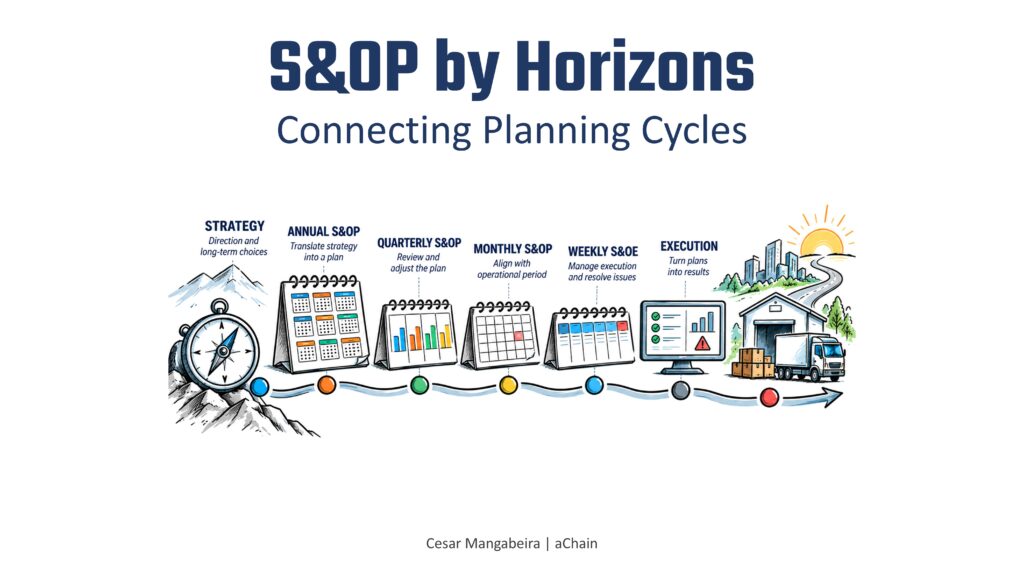
This model can be represented by the following sequence:
S&OP Strategy → Annual S&OP → Quarterly S&OP → Monthly S&OP → Weekly S&OE → Execution
The configuration may vary according to each company, its business model, its level of maturity, its planning cycles, and its decision-making needs.
Some organizations may use all these levels. Others may combine or eliminate certain cycles.
The central point is the connection between the different horizons.
🤝 Sponsored Post: www.achain.com.br
- S&OP Strategy
Strategy establishes the direction that will guide the following cycles.
At this level, the organization may work on decisions related to business positioning, priorities, capacity, portfolio, investments, resources, and expected results.
Supply, Finance, and Demand participate in this process, bringing different perspectives to the same business decision.
Supply contributes perspectives on capacity, resources, and constraints. Finance connects decisions to economic results. Demand translates market conditions, customers, and future needs.
- Annual S&OP
The annual cycle transforms strategic direction into a plan for the following period.
Demand projects future needs. Supply evaluates capacity, resources, inventory, production, and supply. Finance translates scenarios into economic values and projected results.
The annual plan becomes a reference for the following cycles.
- Quarterly S&OP
The quarterly cycle allows the plan to be reviewed in response to changes occurring throughout the year.
Demand updates its projections. Supply reviews capacity, resources, and constraints. Finance reassesses economic impacts and expected results.
The objective is to determine whether the plan remains aligned with the projected scenario and decide which adjustments need to be incorporated.
- Monthly S&OP
Monthly S&OP brings planning closer to the operational period.
Demand presents the evolution of requirements. Supply evaluates service capacity and available resources. Finance reviews the economic impacts of decisions.
The integration of these three major areas allows decisions to consider market conditions, operations, and financial results within the same cycle.
- Weekly S&OE
S&OE operates within a short-term horizon and brings planning closer to execution.
The process continues to involve Supply, Demand, and Finance, although participation and the level of detail may vary according to the company and the nature of the decisions.
Orders, production, availability, inventory, capacity, priorities, and exceptions become relevant elements in decision-making.
When an occurrence changes the plan, S&OE evaluates the situation and directs the required response.
- Execution
Execution transforms decisions into actions.
Producing, purchasing, moving, delivering, fulfilling orders, and adjusting priorities represent the materialization of planning.
Supply acts directly on operations. Demand monitors order behavior and requirements. Finance monitors the economic effects of decisions.
In this way, the three major areas remain connected until the point where the plan meets operational reality.
- S&OP Integrates Company Planning
Advanced S&OP expands the traditional concept of integrated planning. Its purpose is to connect the different components of enterprise planning within a single architecture related to strategy, business, finance, demand, supply, and execution.
The challenge involves connecting different horizons and company areas so that decisions are built from an integrated view of the business.
Within this architecture, planning may involve different reviews according to each company’s structure:
- Demand Review: forecast, demand sensing, demand shaping, and analysis of future requirements.
- Supply Review: inventory, production, procurement, operations, capacity, resources, and constraints.
- Financial Review: costs, budget, results, cash flow, accounting, and controlling.
- Strategy Review: strategic drivers, objectives, priorities, investments, and positioning.
- Business Review: performance, market, portfolio, customers, opportunities, risks, and business decisions.
These reviews may feed the different planning cycles, from strategy through annual, quarterly, and monthly S&OP, reaching S&OE and execution.
Advanced S&OP seeks to connect planning across the entire company. Demand needs to be connected to Supply. Supply needs to be connected to Finance. Finance needs to be connected to Strategy. Strategy needs to be connected to the Business.
Execution needs to return information to higher planning levels when events change the plans.
This architecture allows planning to move away from isolated functional areas and operate as a system of connected business decisions.
The expected result is a view in which strategy, business, demand, supply, finance, and execution participate in the same planning logic, with each contributing its information, analysis, and decisions.
Advanced S&OP therefore represents an evolution of the concept of integration. It seeks to connect the entire company, all relevant horizons, and the main decision cycles, bringing planning closer to business reality and execution.
- The Model Depends on Each Company
Each organization may work with its own configuration.
One company may work with strategic, annual, quarterly, monthly, and weekly S&OE planning.
Another may use only some of these levels.
A third may have additional cycles to address specific business characteristics.
The design needs to consider the decision horizon, frequency of changes, operational complexity, business model, planning maturity, and the need for integration between functions.
The architecture should serve the company and its decision-making process.
- Connecting the Horizons
The logic can be represented by a chain of decisions:
Strategy → Annual → Quarterly → Monthly → Weekly → Execution
Strategy guides annual planning.
The annual plan establishes references for the quarter.
The quarterly cycle directs monthly reviews.
The monthly cycle provides parameters for S&OE.
S&OE directs short-term decisions toward execution.
At the same time, information from execution may return to higher levels when it creates relevant impacts on planning.
This movement creates a connected architecture between planning and execution.
🤝 Sponsored Post: www.achain.com.br
Solutions to the Problem
To build this architecture, three points deserve attention.
First: define which horizons actually make sense for the company.
Second: establish the participation of Supply, Demand, and Finance at each horizon, respecting the role of each function.
Third: define which decisions and information should move from one horizon to the next and which execution information needs to return to planning.
The expected result is a model in which each cycle has its own purpose and remains connected to the others.
Conclusion
S&OP can take on a much broader dimension than a monthly meeting.
The architecture can connect strategy, annual planning, quarterly planning, monthly planning, weekly S&OE, and execution according to each company’s characteristics.
Supply, Demand, and Finance participate in this architecture at different levels, contributing their respective perspectives.
Advanced S&OP seeks to bring planning and execution closer together, reduce the gap between them, and integrate the different components of enterprise planning.
The question is no longer simply how to conduct an S&OP meeting.
It becomes:
How can a planning architecture be built to connect the entire company through execution?
Comments and Sharing
How does your company connect strategy, planning, and execution across different horizons?
Which decision should better connect Strategy, Demand, Supply, and Finance within the S&OP model?