Review, Meeting, Planning or Management? Which Term Should Be Used?
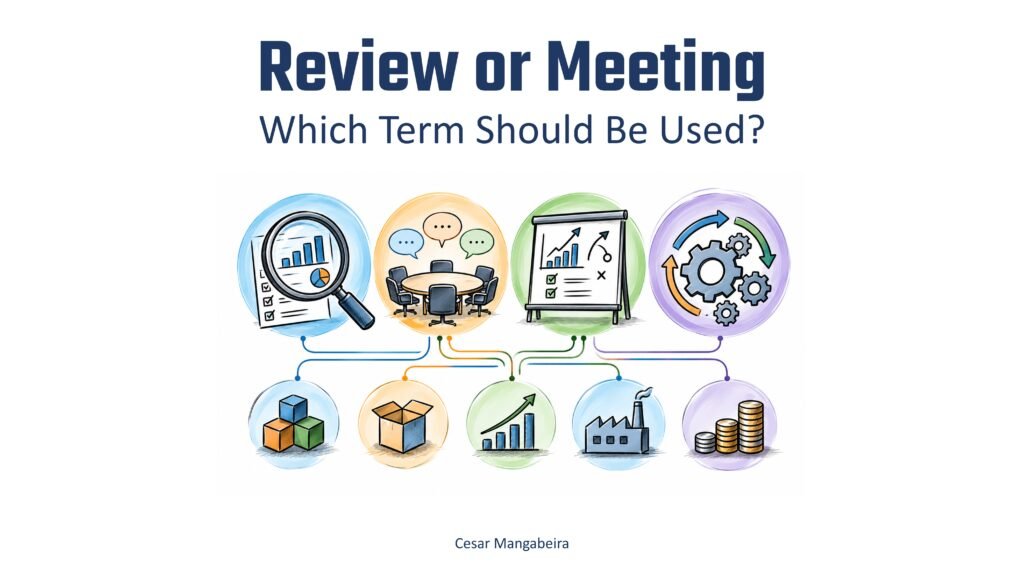

In the S&OP process, the terms Review, Meeting, Planning, and Management are used in connection with different activities, meetings, and management processes. Their combinations with Portfolio, Product, Demand, Supply, and Finance help identify the subject being addressed and the nature of the work being performed.
Understanding the meaning of each term helps organizations define the names used in their processes, agendas, procedures, and corporate documents.
- Review, Meeting, Planning, and Management
Review is a structured activity involving the examination of information, results, assumptions, variances, and proposals. Its purpose is to assess the available information, evaluate the current situation, and identify issues that require analysis or follow-up.
Meeting is a gathering of participants convened to address a defined subject. The term identifies the gathering, while the agenda establishes its objective, the topics to be discussed, and the expected outcomes.
Planning is the activity of developing, analyzing, and adjusting plans for a given time horizon. It may involve volumes, resources, priorities, scenarios, timelines, and the actions required to achieve defined objectives.
Management is an administrative process based on planning, organizing, directing, and controlling, involving communication, influence, people development, and prioritization. When applied to products and services, it encompasses the activities required to guide their development, offering, resources, and results throughout their life cycle.
The four terms represent distinct concepts. Review examines information and results, Meeting brings participants together, Planning develops plans, and Management coordinates activities and decisions over time.
- Naming Variations by Subject
The combinations below illustrate how the four terms can be associated with different dimensions of S&OP. The choice depends on the objective and responsibilities assigned to each activity.
Portfolio
- Portfolio Review
- Portfolio Meeting
- Portfolio Planning
- Portfolio Management
Portfolio Review examines the composition of the portfolio, its priorities, and the results associated with its products.
Portfolio Meeting identifies the meeting dedicated to discussing portfolio-related matters.
Portfolio Planning involves planning the future portfolio composition, considering additions, removals, priorities, and anticipated changes.
Portfolio Management involves the administration of the portfolio, including opportunity assessment, initiative prioritization, and monitoring decisions related to the product portfolio.
Product
- Product Review
- Product Meeting
- Product Planning
- Product Management
Product Review examines information and results related to specific products.
Product Meeting identifies a meeting dedicated to product-related topics, such as launches, changes, and discontinuations.
Product Planning encompasses planning activities related to products, including timelines, resources, launches, and anticipated changes.
Product Management involves the administration of products throughout their life cycle, including decisions about development, positioning, priorities, and results.
Demand
- Demand Review
- Demand Meeting
- Demand Planning
- Demand Management
Demand Review involves reviewing the demand forecast, underlying assumptions, identified variances, and proposals presented by participating functions.
Demand Meeting identifies the meeting dedicated to discussing demand, evaluating information, and addressing relevant issues.
Demand Planning refers to planning demand over a given time horizon, considering historical information, assumptions, opportunities, and future expectations.
Demand Management involves the administration of demand-related activities, including planning, organizing, communicating, influencing, prioritizing, and controlling the demand for products and services.
Supply
- Supply Review
- Supply Meeting
- Supply Planning
- Supply Management
Supply Review examines fulfillment capacity, available resources, constraints, inventory, and risks associated with the plan.
Supply Meeting identifies the meeting dedicated to discussing fulfillment capabilities and Supply-related issues.
Supply Planning involves planning the resources and operations required to meet demand, considering capacity, materials, inventory, and operational constraints.
Supply Management involves the administration of resources and activities related to supply and fulfillment, including planning, organizing, coordinating, prioritizing, and controlling operations.
Finance
- Finance Review
- Finance Meeting
- Finance Planning
- Finance Management
Finance Review involves reviewing financial results, assumptions, variances, and the economic impacts associated with the plans.
Finance Meeting identifies the meeting dedicated to discussing financial topics and their relationship to S&OP decisions.
Finance Planning refers to financial planning, including revenue, costs, margins, inventory, and projected results.
Finance Management involves the administration of financial resources and results, including planning, organizing, monitoring, prioritizing, and controlling financial activities.
- Does the Name Define the Nature of the Activity?
A single dimension may involve review, meetings, planning, and management. The difference lies in the purpose of each activity and the responsibilities assigned to participants.
For example, a Demand Review examines demand information and assumptions. A Demand Meeting identifies the gathering in which participants discuss the subject. Demand Planning refers to developing the demand plan. Demand Management, in turn, encompasses the demand management process, including activities that extend beyond a specific meeting.
The same reasoning applies to Portfolio, Product, Supply, and Finance.
It is important to recognize that the terms are not interchangeable in every context. Management identifies a management process, while Review, Meeting, and Planning may identify specific activities or gatherings within that process.
- How to Choose the Appropriate Term
The choice should consider five criteria:
- Objective: the purpose the activity is intended to fulfill.
- Nature of the work: reviewing information, bringing participants together, developing plans, or managing a set of activities.
- Responsibilities: which decisions belong to the participants and process owners.
- Deliverables: the information, plans, decisions, or follow-up actions expected from the activity.
- Organizational terminology: the terms adopted in procedures, agendas, and documents.
Applying these criteria helps distinguish the name of a meeting from the name of a management process. It also helps prevent distinct activities from receiving the same name without a functional reason.
- Solutions to the Problem
When terms are used without defined criteria, different interpretations may arise regarding the purpose of meetings and the scope of management processes.
To address this problem, an organization can:
- Develop a glossary defining Review, Meeting, Planning, and Management.
- Link each term to its purpose, responsibilities, and expected deliverables.
- Distinguish meeting names from the names of ongoing management processes.
- Adopt a naming convention for Portfolio, Product, Demand, Supply, and Finance.
- Apply the definitions to procedures, agendas, presentations, and training materials.
- Conclusion
Review, Meeting, Planning, and Management represent distinct concepts, with applications that vary according to organizational objectives and context.
While the first three terms may identify specific activities or gatherings, Management characterizes an active management process that integrates different activities, responsibilities, and decisions.
The chosen terminology should reflect the work performed and the intended purpose, allowing participants to understand the meaning of each term within the S&OP process.
Questions
- Could the choice between Review, Meeting, Planning, and Management influence how responsibilities are understood within S&OP? Which criterion do you consider most important when defining these terms?
- Should a Review and a Meeting have distinct purposes in S&OP governance? How would you define the difference between them?