Quick S&OP: an extraordinary response to events that disrupt the plan

Quick S&OP: extraordinary response to events that disrupt the plan
S&OP has a monthly cycle. The organization analyzes Demand, Supply, constraints, alternatives, financial impacts, and decisions within a previously defined calendar.
The business environment can present events that go beyond this calendar. A war, a customs strike with severe impact, a pandemic, a major epidemic, a natural disaster, or another extraordinary event can abruptly change the conditions used to build the plan.
When an event of this magnitude occurs between two monthly cycles, waiting for the next Executive Decision Meeting can leave the organization without an adequate response to the extraordinary event.
This is the context in which Quick S&OP emerges.
Quick S&OP is an extraordinary S&OP mechanism. It can be activated only in the event of severe, disruptive situations that are sufficiently relevant to cause a significant change in the current plan.
Quick S&OP is not part of the monthly S&OP routine. Its existence is related precisely to exception management.
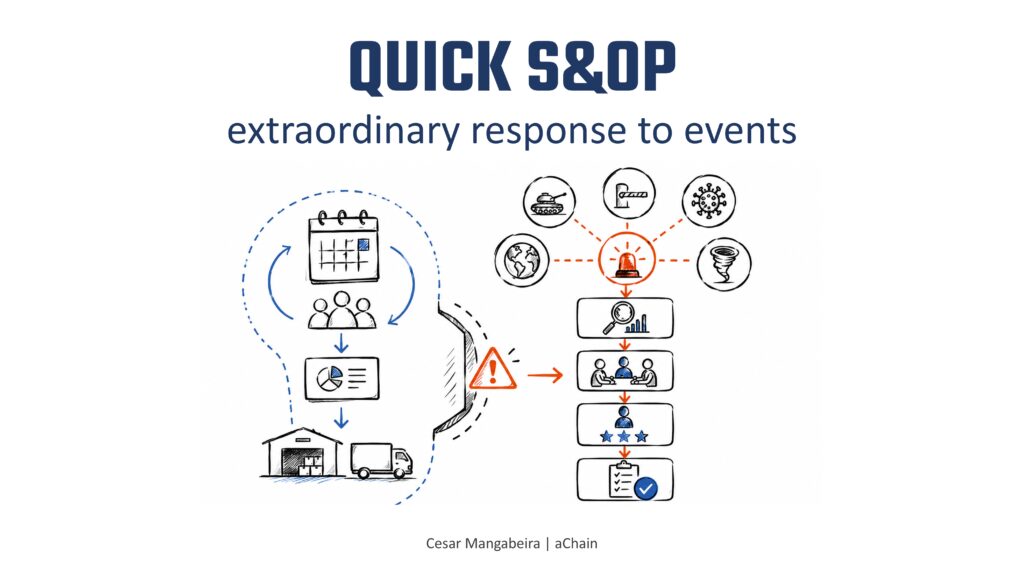
The logic can be represented as follows:
Monthly S&OP
↓
Extraordinary event
↓
Assessment of the need for intervention
↓
Quick S&OP
↓
Extraordinary executive decision
↓
Actions
🤝 Sponsored Post: www.achain.com.br
📚 eBooks list: www.cesarmangabeira.com.br
Collaborative Forecasting, Demand Meeting, Procurement, Semiconductors, and more. Available on Google Play Books and major digital bookstores. Published in Portuguese, English, and Spanish.
- What is Quick S&OP?
Quick S&OP is an extraordinary executive decision meeting, called between S&OP cycles when a severe and extraordinary event significantly changes the conditions of the current plan and requires a new decision before the next Executive Decision Meeting.
The concept does not create a second S&OP calendar. The monthly calendar remains the reference for the process.
Quick S&OP functions as an exception mechanism activated when a situation exceeds the conditions anticipated in the normal cycle.
The logic can be summarized as follows:
Monthly S&OP → extraordinary event → Quick S&OP → executive decision → action
The word Quick refers to the need for a response within a reduced time interval in an exceptional situation.
The term does not mean a simplified S&OP or an additional routine meeting.
- What is an extraordinary event?
An extraordinary event is an occurrence of sufficient magnitude, impact, or combination of factors to disrupt the assumptions of the current plan and require an executive decision before the next Executive Decision Meeting.
The main characteristic is its ability to disrupt the assumptions of the current plan.
An event of this type can simultaneously affect Demand, Supply, capacity, materials, suppliers, inventory, logistics, customer service, and financial results.
Some examples help illustrate the concept:
- a war that creates restrictions on supply, transportation, or international trade
- a customs strike that significantly interrupts or limits the movement of materials
- a severe pandemic that abruptly changes Demand, capacity, or workforce availability
- a major epidemic that creates significant operational restrictions
- a large-scale natural disaster
- a prolonged disruption involving a relevant supplier
- a severe disruption on a logistics route
- an extraordinary regulatory change with an immediate effect on the plan
- a rare geopolitical event that changes supply or market conditions
- an exceptional change in Demand behavior
- an extraordinary change in costs, prices, foreign exchange rates, or financial conditions that modifies the economic assumptions of the plan
The concept of an extraordinary event therefore involves rarity, magnitude, and impact on the plan.
- Does every severe problem generate a Quick S&OP?
No.
This is an important point to prevent Quick S&OP from being confused with an operational escalation meeting.
A problem can be severe and still be managed through normal management mechanisms.
Quick S&OP should be considered when the event:
- has extraordinary magnitude
- changes relevant assumptions of the plan
- produces significant impact on Demand or Supply
- produces relevant financial impact or changes the economic assumptions of the plan
- can compromise decisions made during the current cycle
- requires an executive decision
- needs to be addressed before the next Executive Decision Meeting
The decision to call the meeting should be a governance decision.
Normal event → normal management
Relevant event → assessment
Extraordinary event with impact on the plan → possible Quick S&OP
The meeting therefore remains reserved for exceptional situations.
- Quick S&OP is not a routine meeting
Monthly S&OP has recurrence.
Quick S&OP is an exception.
This distinction needs to be preserved.
A company can go through several S&OP cycles without holding a single Quick S&OP.
The absence of extraordinary meetings may simply indicate that no event has reached the established criteria.
The objective is not to create an additional meeting in the calendar.
The objective is to create a decision mechanism for situations that cannot wait until the next monthly cycle.
Therefore, Quick S&OP should not have a monthly, weekly, or biweekly frequency.
It takes place when an extraordinary event requires its activation.
- The role of Demand
An extraordinary event can rapidly change Demand expectations.
A pandemic can cause an abrupt decline in certain products and an exceptional increase in others.
A war can change markets, trade routes, and customer behavior.
A customs strike can delay products and temporarily change service capacity.
Demand analysis needs to identify:
- what has changed
- the magnitude of the change
- which horizons have been affected
- which products or families have been affected
- which customers or markets have been affected
- which part of the current plan has lost alignment with the new scenario
The objective is to produce an updated Demand view for the extraordinary decision.
- The role of Supply
Extraordinary events can also affect Supply.
A customs strike can block materials.
A war can restrict suppliers, routes, or component availability.
A pandemic can reduce production capacity or workforce availability.
A natural disaster can interrupt production, transportation, or supply.
Supply assessment may involve:
- capacity
- materials
- suppliers
- inventory
- production
- transportation
- lead times
- supply routes
- fulfillment alternatives
The Supply conditions changed by the event and their consequences can significantly modify the current plan.
- The role of Finance
Finance plays a central role in Quick S&OP because a significant change in the plan can modify revenue, costs, margin, capital employed, and financial results.
An extraordinary event can cause lower sales, higher procurement costs, emergency freight expenses, the need for additional inventory, margin losses, foreign exchange impacts, extraordinary investments, or significant changes in working capital.
Financial analysis needs to translate the impacts of Demand and Supply into economic consequences for the organization.
The analysis may include:
- revenue impact
- margin impact
- material cost impact
- logistics cost impact
- extraordinary expense impact
- inventory and working capital impact
- foreign exchange impact
- investment requirements
- impact on financial results
- cash flow impact
- economic impact of the alternatives under consideration
Finance should also participate in the comparison of alternatives.
One alternative may preserve a higher level of customer service while requiring extraordinary costs. Another may reduce costs while causing greater sales losses. A third may require additional investment to recover capacity.
The role of Finance is to quantify these consequences and enable the executive decision to consider the economic impact of each alternative.
Quick S&OP therefore needs to connect three dimensions:
Demand → what the market may require
Supply → what the operation can fulfill
Finance → what the economic impact of each alternative will be
The executive decision takes place through the integration of these dimensions.
- What happens after the Executive Decision Meeting?
This is one of the situations that justify the existence of Quick S&OP.
Imagine that the Executive Decision Meeting took place at the beginning of the month.
The plan was approved.
A few days later, an extraordinary event occurs, such as a war, a severe disruption involving a strategic supplier, a large-scale natural disaster, or a pandemic, creating simultaneous impacts on supply, production, logistics, inventory, customer service, and financial results.
The approved plan remains valid as the reference for the cycle. The conditions used to build it, however, have been changed by an extraordinary event.
The new situation can compromise decisions related to Supply, customer service, inventory, production, priorities, revenue, costs, margin, and working capital.
Waiting until the next Executive Decision Meeting can prolong the impact of the event and leave the current plan in place without a decision regarding the new condition.
In this scenario, Quick S&OP can be called directly as an extraordinary Executive Decision Meeting.
The sequence would be:
Executive Decision Meeting
↓
Approved Plan
↓
Extraordinary Event
↓
Quick S&OP
↓
New Executive Decision
↓
Actions
In this case, Quick S&OP functions as an extraordinary reopening of the decision, triggered by an event that significantly changed the conditions of the current plan.
- How does Quick S&OP work?
The meeting should start from the event that triggered its activation.
The objective is to rapidly assess the impact on the current plan and decide which changes need to be made.
A possible sequence involves:
- Event characterization
What happened, what was its magnitude, and which horizon may be affected?
- Demand impact
Which Demand assumptions have changed?
- Supply impact
Which capacities, materials, suppliers, inventories, or routes have been affected?
- Financial impact
Which revenues, costs, margins, inventories, working capital, investments, and financial results may be affected?
- Gap identification
Which decisions in the current plan need to be reassessed?
- Alternatives
Which options can reduce the operational and financial impact?
- Executive decision
Which alternative will be adopted, and what financial impact was considered?
- Actions
Which activities will be performed, by whom, and within what timeframe?
Quick S&OP may require specific data related to the event. It does not need to reproduce the entire set of analyses used in the monthly cycle.
The meeting should focus on what changed because of the extraordinary event and on the consequences for Demand, Supply, and Finance.
- Who participates in Quick S&OP?
The composition should be determined by the magnitude, scope, and nature of the extraordinary event.
Senior management should participate in Quick S&OP because the meeting has an executive decision-making role and may require significant changes to the current plan, priorities, resources, and commitments.
When the impact is concentrated on Demand, representatives from Sales, Planning, and Management may participate.
When the impact is concentrated on Supply, representatives from Planning, Procurement, Production, Inventory, Suppliers, or Logistics may participate.
When there is a significant financial impact, Finance should participate in the assessment and decision.
Major events may require the direct participation of senior management, particularly when there is significant impact on results, customer service, capacity, investments, risks, or strategic priorities.
The participants in Quick S&OP should be people who possess information relevant to the decision and have the authority to approve the required actions, with senior management occupying the central decision-making role.
Because this is an extraordinary meeting, its composition should be related to the event and the decisions that need to be made.
- When should a Quick S&OP not be called?
Quick S&OP should be called only when there is a critical and extraordinary event with significant impact on the current plan and a need for an executive decision before the next Executive Decision Meeting.
Normal forecast variations should not generate a Quick S&OP.
Isolated supplier delays, operational deviations, normal Demand fluctuations, or problems that can be handled through normal management mechanisms should also not trigger the meeting.
Quick S&OP should never become a routine meeting for simple or recurring events.
When there is no critical and extraordinary event that justifies an executive decision outside the normal cycle, Quick S&OP should not be called.
A useful governance question is:
Does the event have sufficient magnitude to disrupt the assumptions of the current plan, create significant impact on Demand, Supply, or Finance, and require an executive decision before the next Executive Decision Meeting?
If the answer is no, the event should follow the normal management mechanisms.
- Quick S&OP and management by exception
The concept creates a direct connection between S&OP and management by exception.
The monthly cycle organizes recurring planning.
Quick S&OP creates a response for situations that disrupt the assumptions used in that cycle.
The architecture can be visualized as follows:
Routine
Monthly S&OP → decision → execution
Exception
Extraordinary event → Demand, Supply, and Finance assessment → Quick S&OP → extraordinary decision → execution
There is an important difference between the two paths.
The first occurs according to the calendar.
The second occurs because of an extraordinary need.
- The result must be a decision
Quick S&OP should not end with an information update alone.
The meeting needs to produce an executive decision.
The decision may involve:
- changing the plan
- changing priorities
- reallocating capacity
- changing procurement
- reviewing inventory
- changing customer service priorities
- using extraordinary capacity
- revising lead times
- changing suppliers or routes
- reviewing prices
- approving extraordinary costs
- changing investments
- reviewing working capital
- escalating the matter to a higher-level decision
Each decision should produce actions.
The structure can be summarized as:
Decision → Owner → Deadline → Follow-up
The extraordinary meeting therefore generates a concrete response to the event that triggered it.
🤝 Sponsored Post: www.achain.com.br
📚 eBooks list: www.cesarmangabeira.com.br
Collaborative Forecasting, Demand Meeting, Procurement, Semiconductors, and more. Available on Google Play Books and major digital bookstores. Published in Portuguese, English, and Spanish.
Solutions to the problem
The problem faced by S&OP is simple to describe.
The process has a monthly calendar.
Extraordinary events do not have a calendar.
When a war, severe pandemic, customs strike, or another rare event changes business conditions, the organization needs to decide whether to wait for the next cycle or intervene before it.
Quick S&OP provides a mechanism for this situation.
Its structure can consider six elements:
- Monthly S&OP
Maintain the regular cycle as the primary reference.
- Extraordinary event criteria
Define which events have sufficient magnitude to justify an intervention.
- Impact assessment
Analyze the consequences for Demand, Supply, Finance, and the current plan.
- Call decision
Determine whether the situation requires an extraordinary executive meeting.
- Quick S&OP
Bring together the required participants, assess alternatives, make the decision, and define the actions.
- Financial assessment of alternatives
Quantify the economic consequences of the options under consideration and incorporate this information into the executive decision.
This design prevents Quick S&OP from becoming an additional routine meeting.
It preserves its role as an exception mechanism and connects the extraordinary response to operational and financial consequences.
Conclusion
S&OP has a monthly cycle because planning requires a recurring structure.
Extraordinary events follow a different logic.
A war, a customs strike, a severe pandemic, a major epidemic, a natural disaster, or another rare event can rapidly change the conditions used to build the plan.
When this occurs between two cycles, waiting for the next Executive Decision Meeting can represent a risk for the organization.
Quick S&OP creates a response for situations of this nature.
Monthly S&OP → extraordinary event → Demand, Supply, and Finance assessment → Quick S&OP → executive decision → action
Quick S&OP does not replace S&OP.
Quick S&OP is not part of the monthly routine.
Quick S&OP exists as an exception to the monthly calendar, reserved for severe events that can significantly change the current plan and require an executive decision before the next cycle.
The participation of Finance improves the decision process by allowing the organization to assess the economic consequences of the alternatives before the executive choice.
In one sentence:
Quick S&OP is the extraordinary mechanism that allows an S&OP decision to be reopened when a rare and severe event disrupts the assumptions of the current cycle and changes the conditions of Demand, Supply, or Finance.
Comments and sharing
- Faced with a critical and extraordinary event that significantly changes the current plan, should the organization wait for the next Executive Decision Meeting or call a Quick S&OP?
- What criteria should determine whether an event has sufficient impact on Demand, Supply, and Finance to justify calling a Quick S&OP?