
PLF Promotional Lift Factor: How to Relate Promotional Sales to the Baseline
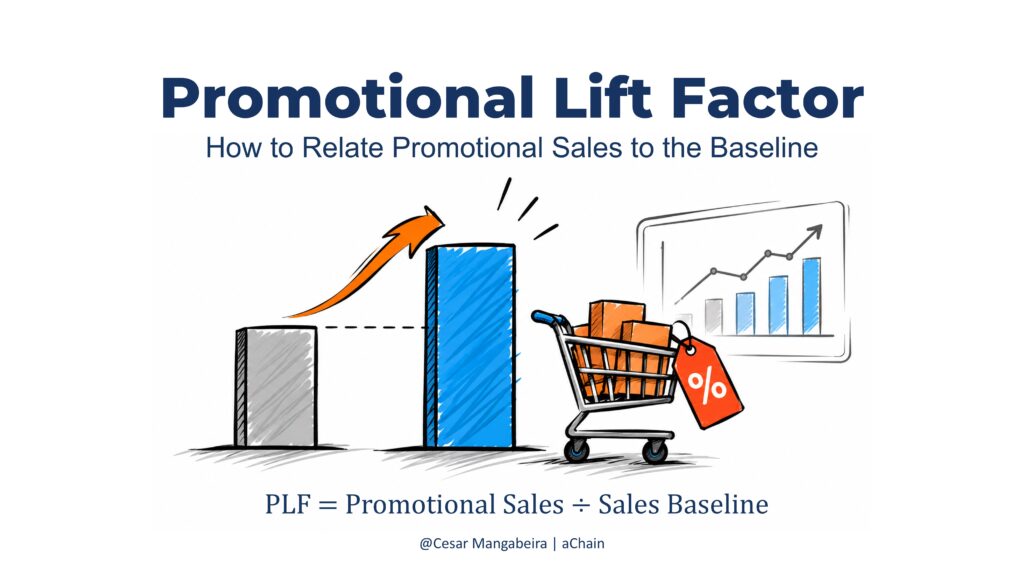

How can we measure the impact of a promotion on sales?
PLF, Promotional Lift Factor, relates promotional sales to the sales baseline and indicates how much sales generated during a promotion represent compared with the level expected without the promotional action.
🤝 Sponsored Post: www.achain.com.br.
- What Is PLF?
PLF (Promotional Lift Factor) is a factor used to compare sales generated during a promotion with the expected sales level without the promotional action.
PLF = Promotional Sales ÷ Sales Baseline
Consider a product with a baseline of 1,000 units and promotional sales of 1,300 units:
PLF = 1,300 ÷ 1,000 = 1.30
A PLF of 1.30 indicates that promotional sales reached 130% of the baseline, corresponding to a 30% increase over the expected level.
The concept can also be expressed as Promotional Lift (%):
Promotional Lift (%) = (PLF − 1) × 100
In this example:
Promotional Lift (%) = (1.30 − 1) × 100 = 30%
Therefore, PLF 1.30 corresponds to a Promotional Lift of 30%.
PLF presents the factor. Promotional Lift presents the corresponding percentage increase.
- How Should PLF Be Interpreted?
Interpretation can be based on three reference points:
PLF = 1.00
Promotional sales correspond to the baseline.
PLF > 1.00
Promotional sales are above the expected level.
PLF < 1.00
Promotional sales are below the expected level.
The result, however, depends on the quality of the reference used in the calculation. A high PLF may reflect an effective promotion or a distortion in the baseline estimate.
- How Should the Baseline Be Defined?
The baseline represents the sales that would be expected without the promotion.
Its estimate can use different methods depending on demand behavior. Historical sales can be combined with moving averages, trend, seasonality, calendar effects, and other factors that influence the expected volume.
The selected method should represent the behavior that would have been observed in the absence of the promotion.
Consider promotional sales of 1,300 units again. If the baseline is estimated at 1,000 units, the PLF is 1.30. If the correct baseline were 1,100 units, the PLF would be:
PLF = 1,300 ÷ 1,100 = 1.18
The same promotion can therefore produce different results depending on the reference used.
- What Can Distort Promotional Lift?
An increase in sales during a promotion does not necessarily represent incremental gain for the business.
Cannibalization
A promotion on one product may reduce sales of another product in the same category. The growth of the promoted item should be analyzed together with the behavior of other items.
Pull Forward
Some sales may have been brought forward. A customer who would have purchased later makes the purchase during the promotion, increasing volume in the promotional period while reducing future sales.
Halo Effect
A promotion can positively influence other related products. The impact needs to be observed beyond the item directly promoted.
Gross Lift and Net Lift
Gross lift considers the observed increase in the promoted product. Net lift seeks to identify the incremental gain after considering effects such as cannibalization and sales pulled forward.
Therefore, a high PLF needs to be interpreted within the behavior of the category and the period analyzed.
- How Can PLF Be Used in Management?
PLF can turn the history of promotions into information for future decisions.
Compare promotions
Evaluate which actions generated the strongest response relative to the baseline.
Compare products
Identify differences in promotional response across products and categories.
Analyze periods
Observe how the indicator varies across different periods, conditions, and campaigns.
Plan future promotions
Use historical results as a reference for estimating potential responses to future promotional actions.
Evaluate incremental results
Relate PLF to effects that may change the interpretation of promotional volume.
🤝 Sponsored Post: www.achain.com.br.
- Does PLF Mean a Promotion Is Profitable?
A high PLF does not necessarily mean that the promotion generated a positive financial result.
The economic evaluation needs to consider incremental volume, promotional price, discount, margin, campaign cost, and other costs associated with the promotion.
A promotion can generate a PLF of 1.50 and still produce a financial result below expectations when the discount significantly reduces the margin.
Therefore, PLF should be used as an indicator of sales response, while profitability should be evaluated through complementary financial indicators.
Solutions to the Problem
A structured promotion evaluation can follow five steps:
- Estimate the baseline
Define the expected sales without the promotion using a method appropriate to demand behavior. - Calculate PLF
Compare promotional sales with the baseline.
PLF = Promotional Sales ÷ Sales Baseline
- Identify promotional effects
Evaluate cannibalization, Pull Forward, Halo Effect, and other factors that may affect the interpretation of the result. - Evaluate net lift
Separate the observed increase from the gain that is effectively incremental to the business. - Evaluate profitability
Relate the incremental result to promotional discounts, margin, and campaign costs.
Conclusion
PLF, Promotional Lift Factor, relates promotional sales to the baseline and measures sales response during a promotional action.
A PLF of 1.30 represents sales equivalent to 130% of the baseline and a Promotional Lift of 30%.
The quality of the result depends on the definition of the baseline and the analysis of effects that may distort observed volume. Cannibalization, Pull Forward, and Halo Effect can change the interpretation of the lift.
PLF also does not measure profitability. To evaluate the financial result of a promotion, the indicator needs to be analyzed together with incremental effects, margin, discounts, and campaign costs.
Comments and Sharing
When evaluating a promotion, which should receive greater attention: the calculated PLF or the quality of the baseline?
Is a high PLF sufficient to classify a promotion as successful?
📚 See the catalog:
aChain Management: www.achain.com.br