
OTD: On Time Delivery, the delivery time indicator
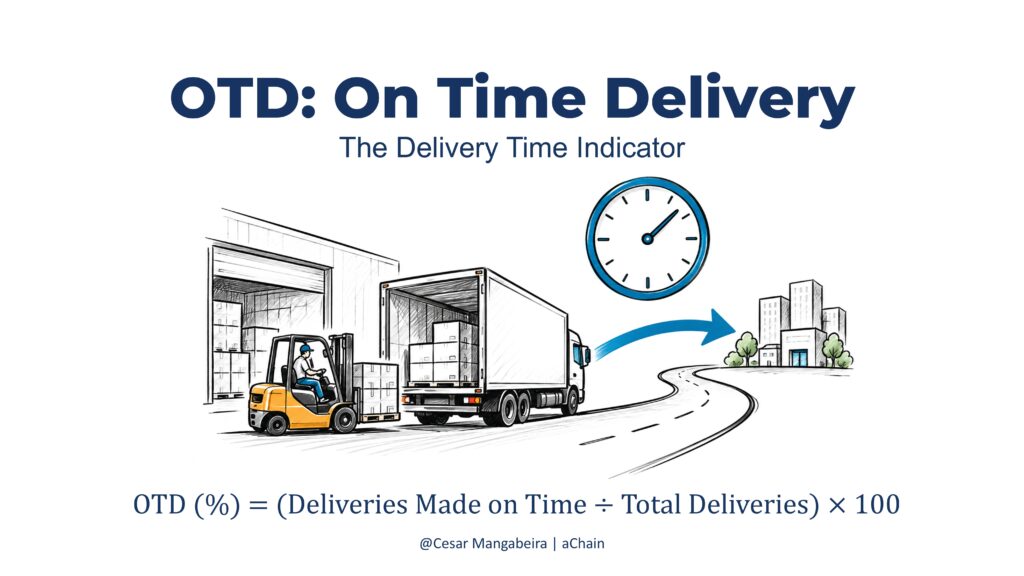

OTD: On Time Delivery, the delivery time indicator
Delivering on time represents one of the main dimensions of delivery performance. The OTD, On Time Delivery, indicator measures the percentage of deliveries completed within the date agreed with the customer.
When the agreed delivery date is missed, impacts can arise across planning, inventory, scheduling, transportation, and customer relationships. OTD turns compliance with the delivery date into a measure that can be monitored over time.
🤝 Sponsored Post: https://www.achain.com.br/
- What Is OTD?
OTD, On Time Delivery, measures the percentage of deliveries completed within the agreed delivery date.
The formula can be presented as follows:
OTD (%) = (Deliveries Made on Time ÷ Total Deliveries) × 100
The calculation depends on the definition used to classify a delivery as completed on time. The customer-promised date is commonly used as the reference.
OTD measures exclusively compliance with the agreed delivery time, considering the delivery date and time. Percentages related to items, lines, or quantity fulfilled are part of OTIF.
- What Does OTD Reveal?
OTD shows the percentage of deliveries made within the established date and time.
A low result indicates that deliveries occurred outside the agreed timeframe. These occurrences may be related to material shortages, production problems, capacity constraints, scheduling failures, or logistics delays.
OTD presents the result of delivery time compliance. An analysis of the causes of delays helps explain the result and guide management actions.
- The Promised Date Is Part of the Indicator
OTD depends directly on the date used as the reference.
Order receipt date, requested date, promised date, confirmed date, and shipping date represent different events. When each area uses a different reference, the indicator can produce divergent results.
The date used in the calculation should be documented in the indicator rule. The same reference should be applied across the periods being analyzed.
- OTD and Delays
The indicator can be complemented by an analysis of delays.
A delivery completed one day after the agreed date will be classified as late when the OTD rule considers the promised date as the deadline for meeting the commitment. A delivery completed ten days later will follow the same classification.
The OTD percentage does not show the number of days of delay. For this reason, the interval between the promised date and the actual delivery date can complement the indicator.
- OTD and Actual Delivery Date
OTD compares the agreed date with the actual delivery date.
When the delivery occurs within the established period, it is classified as on time. When it occurs after the agreed date, it is classified as late.
The indicator rule should define which date represents the commitment and which event characterizes the completion of the delivery.
The focus remains on meeting the delivery date. The quantity delivered belongs to another evaluation criterion.
- OTD and OTIF
OTD and OTIF have related concepts, although they measure different dimensions of delivery performance.
OTD evaluates whether the delivery occurred within the agreed date.
OTIF considers two criteria: On Time, related to meeting the delivery date, and In Full, related to fulfilling the agreed quantity in full.
Therefore, a delivery can meet the agreed date and have a positive OTD result, while complete quantity fulfillment is evaluated through the Full criterion of OTIF.
Distinguishing the indicators prevents OTD from being used to evaluate a dimension that belongs to OTIF.
- How Can OTD Be Improved?
Improving OTD starts with identifying the causes associated with delays.
Actions can be structured around the main factors identified:
- Review delivery promise rules.
- Separate delays by cause.
- Assess material and capacity constraints.
- Analyze adherence to the production plan.
- Review transportation-related occurrences.
- Monitor changes made after the order was placed.
- Define responsibilities for addressing recurring causes.
The analysis should connect the indicator result with actions designed to address the identified occurrences.
- Conclusion
OTD turns compliance with the agreed delivery date into an objective performance measure.
Its use requires a consistent definition of the commitment date, the actual delivery date, and the criteria for classifying a delivery as completed on time.
When the indicator is combined with an analysis of the causes of delays, the result can guide decisions related to planning, production, inventory, and logistics.
Comments and Sharing
Which decision should receive priority when OTD declines repeatedly: reviewing the delivery promise or investigating the causes of delays?
How would you structure OTD to identify the main factors affecting delivery performance?