
I Don’t Need S&OP! When Planning Doesn’t Change the Results
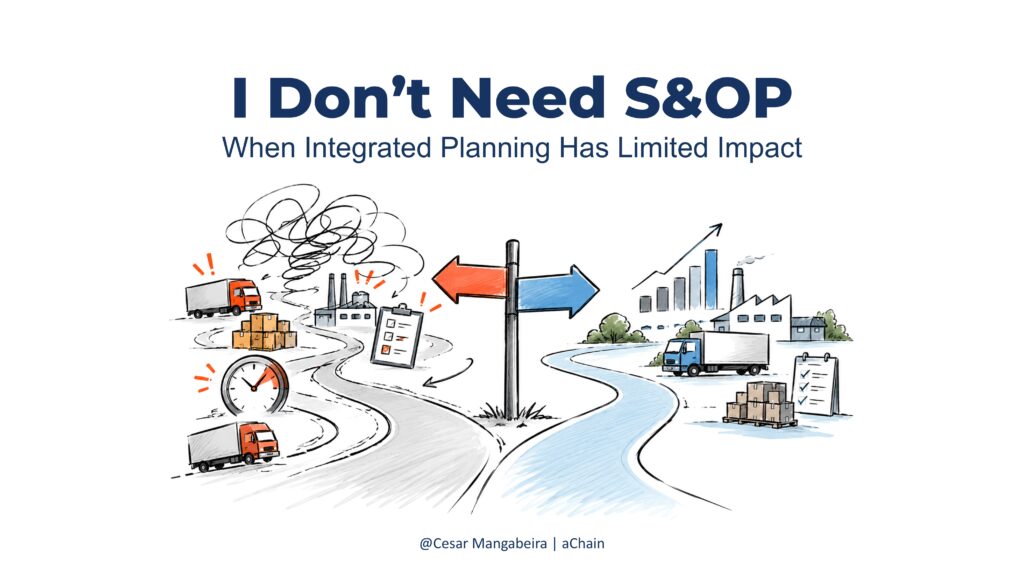

During an S&OP training session, I had difficulty convincing one participant that their company needed the process. At the time, I defended the importance of integrated planning, as I usually do. Later, I began to consider another possibility: perhaps that organization had conditions under which S&OP would have a limited impact.
This reflection led to an interesting question. Under what circumstances can a company operate without integrated planning and avoid significant consequences for its results?
S&OP connects decisions about demand, capacity, supply, inventory, resources, and financial objectives. Its value depends on the characteristics of the business and the problems that anticipating decisions helps solve.
Important: The presence of any single condition listed below does not mean that S&OP will have a limited impact on the company. Having a total lead time close to zero, for example, does not eliminate the value of anticipating decisions about demand, capacity, supply, and resources. The impact of integrated planning depends on the characteristics of each industry and business model, market conditions, demand behavior, supply constraints, production processes, operational flexibility, and resource availability. The possibility of limited impact must be assessed by considering the combination of these conditions, the weight of each one, and their interdependencies. The more these characteristics coexist, and the smaller the effect of inadequate planning on business results, the greater the possibility that S&OP will deliver limited benefits.
🤝 Sponsored Post: www.achain.com.br.
- Customers Can Wait
If customers accept long lead times and occasional delays, the company has time to respond to their needs. Demand anticipation loses some of its value when a later response still meets commercial expectations.
- There Is No Need to Make Decisions in Advance
Some decisions can be made when the need arises without causing significant losses. If the organization can hire, purchase, produce, or distribute within the required timeframe, advance planning tends to have a limited impact on results.
- Total Lead Time Is Very Short (Approaching Zero)
When the interval between identifying a need and delivering the product approaches zero, the response can occur almost immediately. The company depends less on anticipating demand, materials, capacity, and resources, provided that all these activities can keep pace with incoming requests.
- Service Levels Are Not a Concern
If customers tolerate variations in delivery times, availability, and quantities delivered, service levels may have little influence on commercial results. In this scenario, the benefits of coordinating demand and supply in advance tend to be limited.
- Money Is Not a Problem
An organization with abundant capital can absorb high inventory levels, urgent purchases, idle capacity, and unexpected expenses. Integrated planning can still help allocate resources, although financial constraints have less influence on decisions.
- Costs Are Not a Concern
When costs receive little attention in decision-making, waste, excess inventory, overtime, and emergency purchases may be tolerated. Under these conditions, coordination between departments loses some of its economic value because cost reduction is not a management priority.
- No Competitors or Substitutes
Without significant competitors or substitute products, a company may face less pressure to adjust prices, availability, and delivery times. Demand tends to be less sensitive to operational failures when customers have few alternatives. Even so, economic, technological, and regulatory factors can change the situation.
- The Market Does Not Change
In a stable market, with few changes in demand, prices, products, and supply conditions, decisions based on historical data may continue to work for long periods. The need to review plans frequently decreases when the underlying assumptions remain valid.
- There Is No Need for Improvement
If current results meet the organization’s objectives and there are no significant improvement targets, the pressure to improve planning may be limited. The situation changes when new requirements emerge regarding profitability, service, productivity, or growth.
- Production Is 100% Flexible and Adaptable
An operation capable of producing any item, in any quantity, at the requested time, without significant costs or constraints, would have little need to anticipate the relationship between demand and capacity. In practice, total flexibility is an extreme assumption because equipment, materials, people, and processes usually impose limits.
- Demand, Supply, Processes, and Other Resources Are Predictable and Unaffected by the Lack of Planning
If demand, supply, processes, and resources behave predictably, the organization can make decisions with a lower risk of unexpected events. The determining condition is that the absence of integrated planning must not cause imbalances, delays, losses, or conflicts between departments.
- Capacity Is Easy to Manage
When capacity can be adjusted quickly, at low cost, and without compromising service, the company can respond to changes as they arise. The need to anticipate hiring, investments, shifts, and resources decreases when adjustments can be made within the required timeframe.
- Execution Is Excellent and Resolves All Problems Caused by the Lack of Planning
Exceptional operational execution can compensate for some planning failures through rapid decisions, good coordination, and problem-solving. However, execution operates within existing conditions. When a decision requires advance preparation to produce results, acting well in the present may not recover the time lost.
- What If AI Could Do Everything?
Imagine an AI capable of forecasting demand, anticipating supply disruptions, adjusting capacity, optimizing inventory, and coordinating resources automatically. In this scenario, would S&OP play a smaller role? Even with technologies capable of automating analyses and recommending decisions, conflicts between objectives, resource constraints, and choices requiring managerial judgment would remain. AI can transform planning and execution, but its results depend on the characteristics of the business and the decisions that need to be made. An advanced AI system could solve many operational challenges, but decision integration would remain necessary as long as conflicting objectives, constraints, and choices requiring coordination between departments continued to exist.
🤝 Sponsored Post: www.achain.com.br.
Solutions for Assessing the Need for S&OP
- Assess the Consequences of Inadequate Planning
Identify what happens when demand changes, suppliers are delayed, capacity becomes insufficient, or financial objectives conflict. The key is to determine whether the organization can absorb these situations without significant losses.
- Determine How Much Time Decisions Require
Compare the available response time with the time needed to purchase materials, hire people, adjust capacity, and serve customers. When decisions must be made before the need arises, anticipation becomes more important.
- Calculate the Cost of Improvisation
Consider emergency purchases, excess inventory, lost sales, overtime, idle capacity, delays, and tied-up capital. The combined effects may reveal costs that go unnoticed when each department solves its problems in isolation.
- Examine Conflicts Between Objectives
Determine whether decisions made by one department harm the results of another. An action that improves service may increase inventory or expenses, while a cost reduction may limit product availability. Integrated planning makes it possible to discuss these trade-offs from a unified perspective of business results.
- Determine the Value S&OP Can Generate
Define which decisions need to be anticipated, which departments should participate, and which indicators will demonstrate the results. If the process does not change relevant decisions or produce identifiable benefits, its structure should be reassessed.
Conclusion
It is possible to imagine companies in which integrated planning has a limited impact. However, several favorable conditions would need to coexist, ranging from market stability to operational flexibility and the ability to resolve problems during execution.
In practice, each condition deserves careful examination. A stable market can coexist with capacity constraints. Available capital can conceal waste. Good execution can resolve daily issues, while long-term decisions still require advance preparation.
There is no representative study that establishes an exact percentage of companies that could operate without S&OP. The conclusion must be based on the characteristics of each organization and the effects observed when decisions are no longer integrated.
The decisive question is: Which results would be affected if the company stopped planning in an integrated way? The answer helps distinguish a process with limited value from one whose absence could compromise business objectives.
Comments and Discussion
- Can a company grow for long periods without integrated planning, or does this condition tend to limit its results?
- If execution resolves day-to-day problems, where should the line be drawn between reacting and anticipating decisions?
- Will artificial intelligence make S&OP unnecessary, or will business decisions still need to be integrated even with automated planning?