Demand-Driven S&OP or Supply-Driven S&OP: Who Really Drives the Planning Process?

Demand-Driven S&OP or Supply-Driven S&OP: Who Really Drives the Planning Process?
For many years, S&OP has been presented as a process naturally driven by demand. After all, the sales forecast is typically the starting point for nearly every planning decision.
In practice, however, many companies operate in exactly the opposite way. Even with a well-structured Demand Review Meeting, the process is ultimately driven by Supply.
This distinction completely changes the dynamics of S&OP and helps explain why organizations that appear equally mature often achieve very different results.
🤝 Sponsored Post: https://www.achain.com.br/
- Demand-Driven S&OP
In a Demand-Driven S&OP model, the process begins with market demand.
The organization seeks to understand how much customers will purchase, which products will experience higher demand, and what changes may occur throughout the planning horizon.
Only after this stage does Supply begin analyzing capacity, materials, inventory, production, suppliers, and logistics.
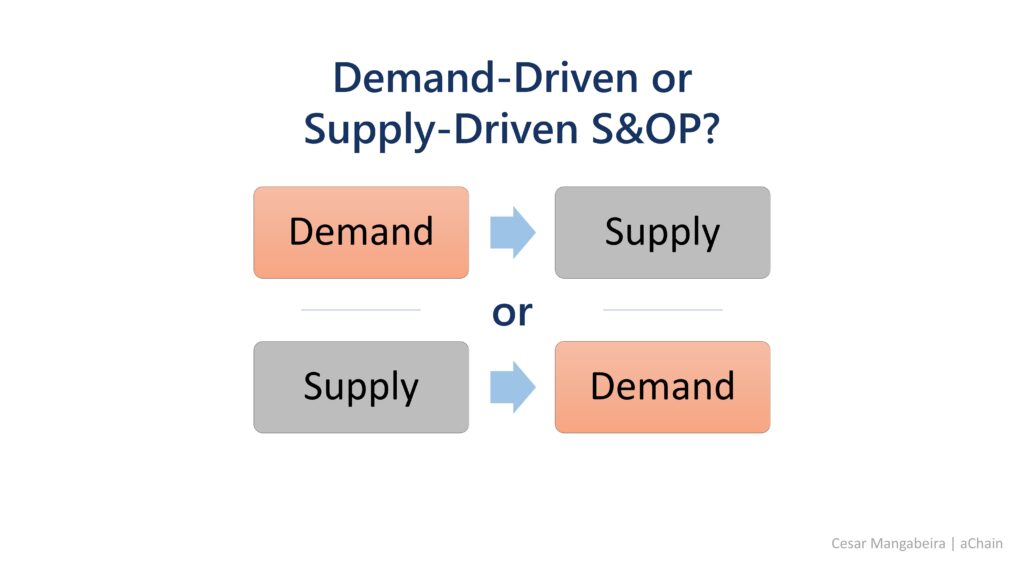
The flow becomes:
Demand → Supply
In this scenario, operations work to meet market needs by adjusting capacity, resources, and inventory whenever possible.
Naturally, constraints will exist. However, they are treated as limitations to be managed rather than the primary factor determining commercial decisions.
- Supply-Driven S&OP
In many organizations, the opposite occurs.
Installed capacity, raw material availability, production constraints, or logistics limitations ultimately determine what can actually be sold.
In this case, the flow becomes:
Supply → Demand
The commercial organization no longer builds its forecast based solely on market expectations. Instead, it considers what the company is capable of producing or delivering.
In practice, demand is adjusted to operational constraints.
This model commonly emerges in environments characterized by:
- limited capacity;
- production bottlenecks;
- material shortages;
- critical suppliers;
- logistics constraints;
- markets where demand exceeds capacity;
- continuous process industries.
- An analogy with pull and push systems
This distinction closely resembles the concepts of pull and push production systems.
In pull systems, customer consumption triggers the entire supply chain.
Demand-Driven S&OP follows a similar logic, with the market driving the rest of the planning process.
In push systems, production determines what will be made available to the market.
Likewise, in Supply-Driven S&OP, operational constraints directly influence the sales forecast and commercial decisions.
Although these concepts are not identical, the analogy helps explain which factor truly has the greatest influence on the planning process.
- Neither model is right or wrong
Being Demand-Driven does not necessarily indicate greater maturity.
Likewise, being Supply-Driven does not imply poor management.
Everything depends on the competitive environment.
For example, the semiconductor industry naturally tends to become strongly Supply-driven during periods of shortage.
Consumer goods companies with available capacity, on the other hand, generally make decisions based primarily on demand.
The real problem arises when an organization believes it operates under one model while, in reality, following the other.
Without this understanding, conflicts often emerge among Sales, Operations, Procurement, and Production.
- The real challenge of S&OP
Perhaps the most important question is not which model should be adopted.
The strategic challenge is identifying what truly drives the organization’s planning decisions.
Once everyone understands whether the process is being driven by Demand or by Supply, it becomes much easier to establish priorities, define responsibilities, and align expectations across all functions involved in S&OP.
📚 Discover my eBooks: https://www.cesarmangabeira.com.br/
Collaborative Forecasting, Demand Review Meeting Management, Procurement, Semiconductors, and more.
Available on Google Play Books and major digital bookstores. Published in Portuguese, English, and Spanish.
Solutions
The first step is recognizing which logic truly governs the company’s planning process.
Once this has been identified, the organization can align its S&OP process, performance indicators, meetings, and decision-making criteria with its operational reality.
At times, Demand will naturally become the primary driver. In other situations, Supply will assume that role. What matters most is ensuring that everyone understands which factor is driving decisions and uses this understanding to strengthen alignment across the organization.
Conclusion
There is no single way to conduct S&OP.
Some organizations make nearly every planning decision based on Demand. Others are primarily constrained by operational limitations that determine what can actually be sold.
Recognizing this distinction improves the quality of discussions, reduces cross-functional conflicts, and enables the S&OP process to reflect how the business truly operates.
Comments and sharing
Does your company operate with a pull-based or push-based S&OP?
When capacity or material constraints arise, does S&OP adjust Supply to meet Demand, or adjust Demand to meet Supply?