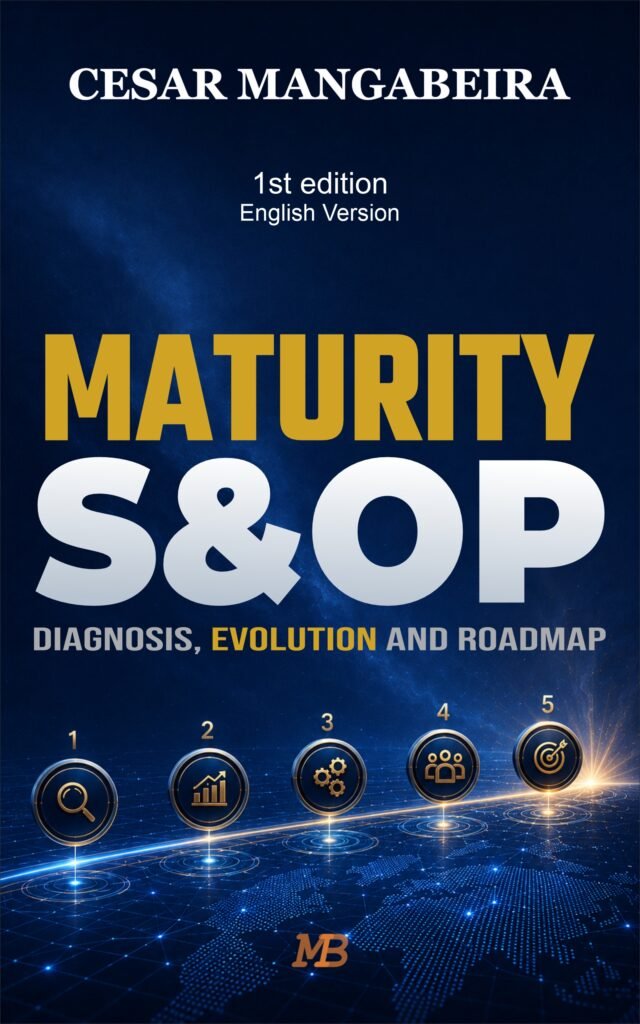
S&OP Maturity: Diagnosis, Evolution and Roadmap
Sinopse
Imagine discovering exactly what stage of S&OP maturity your company has reached, which capabilities need to evolve, and how to turn this knowledge into a development path capable of improving decisions and results. S&OP maturity can be assessed in a structured way, allowing you to understand the current condition, identify opportunities for evolution, and establish a coherent path forward.
This book presents a complete approach to understanding, diagnosing, and evolving S&OP maturity. You will find a model organized into five progressive levels — Reactive, Basic, Structured, Advanced, and End-to-End — allowing you to recognize different stages of development and understand what characterizes each one.
Throughout the book, you will understand how maturity relates to planning capability, decision integration, the relationship with execution, and the different dimensions that make up S&OP. The book also presents diagnosis as a tool for turning perceptions about the process into a structured assessment of the organization’s current situation.
One of the book’s central resources is the maturity checklist, consisting of 50 questions distributed across the five levels, allowing you to identify the highest level whose characteristics are present. Applying the checklist provides an initial view of maturity. The broader assessment allows you to deepen this view by relating the results to maturity dimensions, gaps, and the capabilities that need to evolve.
You will learn how to consolidate assessments, classify results, analyze maturity by dimension, and understand the relationship between different capabilities. This perspective allows you to recognize imbalances that can remain hidden when maturity is reduced to a single score.
The book then moves to a decisive question: how can diagnosis be transformed into evolution? You will learn how to identify maturity gaps, analyze their causes, select solutions, and establish development priorities. Evolution across the five levels is presented as a progressive journey, allowing you to understand the conditions required to move from one stage to the next.
In the chapter dedicated to the roadmap, you will find the foundations for transforming the desired stage into an organized development path. Defining the destination, sequencing initiatives, assigning responsibilities, establishing monitoring indicators, reviewing the roadmap, and following the evolution provide an integrated view of the maturity journey.
By mastering this approach, you will be able to better assess the condition of S&OP, identify the greatest development opportunities, direct improvement investments, and make more informed decisions about the evolution of the process. For professionals involved in S&OP, planning, Supply Chain, Demand, Finance, and management, the knowledge presented provides a foundation for turning maturity into an organizational development tool.
You will be able to move from a general perception of S&OP maturity toward a structured understanding of where the organization is, where it intends to go, which gaps need to be addressed, and how to organize its evolution.
S&OP Maturity: Diagnosis, Evolution and Roadmap was developed for those who want to understand maturity as a tool for analysis and transformation. By the end of the book, you will be better prepared to assess the current stage, recognize opportunities, set priorities, and build an evolution path capable of contributing to better decisions and superior results.
Disponível nas principais livrarias e plataformas digitais.
Sumário
1 S&OP Maturity
1.1 What Is S&OP Maturity
1.2 Stages of S&OP Development
1.3 Maturity and Planning Capability
1.4 Maturity and Decision Integration
1.5 Maturity and Its Relationship to Execution
1.6 Maturity as a Diagnostic Object
1.7 Topics
2 S&OP Maturity Levels
2.1 The reactive level
2.2 The basic level
2.3 The structured level
2.4 The advanced level
2.5 The End-to-End level
2.6 Topics
3 The Structure of S&OP Maturity
3.1 Dimensions of maturity
3.2 Demand, Supply, and Finance
3.3 Integration, planning, and execution
3.4 The relationships between the dimensions
3.5 The S&OP maturity model
3.6 Topics
4 The maturity diagnosis
4.1 The purpose of the diagnosis
4.2 The object of the diagnosis
4.3 The scope of the diagnosis
4.4 The evidence of the diagnosis
4.5 The sources of evidence
4.6 Diagnostic participants
4.7 The preparation of the diagnosis
4.8 Conducting the diagnosis
4.9 Topics
5 The S&OP Maturity Checklist
5.1 The Origin of the S&OP Maturity Checklist
5.2 How the Checklist Is Organized
5.3 Checklist Level 1 – Reactive
5.4 Checklist Level 2 – Basic
5.5 Checklist Level 3 – Structured
5.6 Checklist Level 4 – Advanced
5.7 Checklist Level 5 – End-to-End
5.8 Interpretation of the Results
5.9 Topics
6 Chapter 6. S&OP Maturity Across Its Dimensions
6.1 Demand Maturity
6.2 Supply Maturity
6.3 Financial Maturity
6.4 The Maturity of Integration
6.5 The Maturity of Planning and Execution
6.6 Topics
7 Chapter 7. Consolidation and the Maturity Matrix
7.1 The Consolidation of Assessments
7.2 Classification of Results
7.3 The Result by Dimension
7.4 The Overall Maturity Result
7.5 The S&OP Maturity Matrix
7.5.1 The S&OP Maturity Matrix
7.6 Imbalances between the Dimensions
7.7 Topics
8 Gaps and Maturity Evolution Solutions
8.1 The Current Stage and the Desired Stage
8.2 The Maturity Gaps
8.3 Maturity Gaps by Dimension
8.4 Solutions for the Gaps
8.5 Solution Selection
8.6 Solution Prioritization
8.7 Topics
9 Evolution Between Maturity Levels
9.1 The Logic of Evolution between Maturity Levels
9.2 The Evolution from Reactive to Basic
9.3 The Evolution from Basic to Structured
9.4 The Evolution from Structured to Advanced
9.5 The Evolution from Advanced to End-to-End
9.6 The Conditions for Advancing to the Next Level
9.7 Topics
10 The Maturity Evolution Roadmap
10.1 Defining the Desired Maturity Stage
10.2 The Sequencing of Initiatives
10.3 The Responsibilities for Maturity Evolution
10.4 The Monitoring Indicators
10.5 The Roadmap Review
10.6 Monitoring Maturity Evolution
10.6.1 Monitoring Evolution
10.6.2 Verifying the Trajectory
10.6.3 Capability Evolution
10.6.4 Identifying Deviations
10.6.5 Updating the Trajectory
10.6.6 Integrating Monitoring
10.7 Topics
Disponível nas principais livrarias e plataformas digitais.