
What Is S&OE (Sales and Operations Execution)?
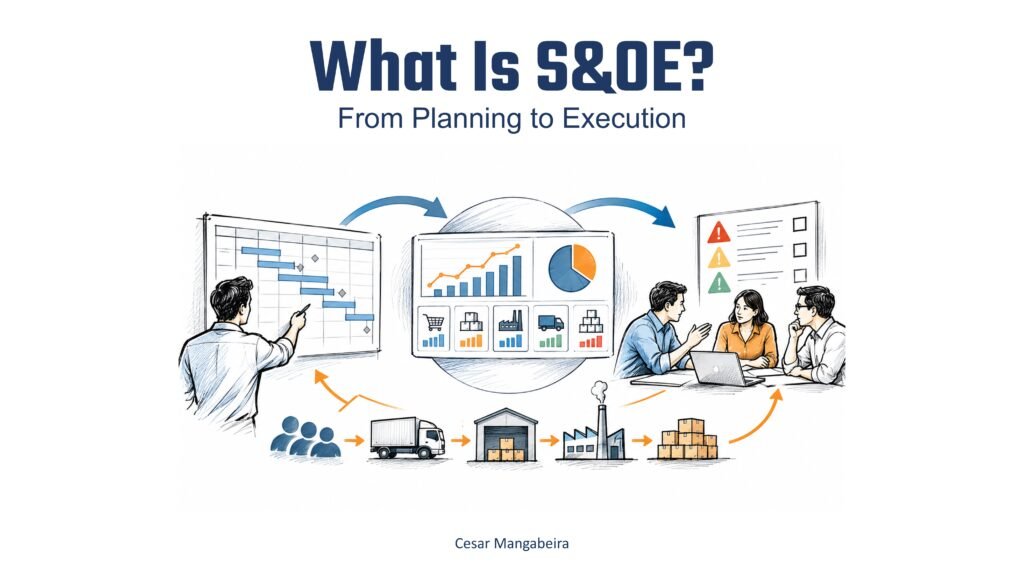

S&OE (Sales and Operations Execution) is the process that connects the tactical plans defined in S&OP with operational execution, monitoring weekly commitments, performance indicators, and deviations.
S&OE connects the tactical plans defined in S&OP with operational execution, coordinating the breakdown of these plans into weekly commitments and promoting alignment among the areas involved to keep execution focused on established objectives.
This work is organized around five pillars:
- Plan Deployment
- Control and Performance Indicators
- Deviation Management
- Action Coordination
- Meetings and Escalation
The 5 Pillars of S&OE
- Plan Deployment
- Translate S&OP tactical plans into weekly execution commitments.
- Break down planned volumes into targets for each period.
- Define fulfillment priorities and execution sequences.
- Identify material, capacity, and resource requirements.
- Consider Supply constraints and commitments made to customers.
- Communicate targets, priorities, and deadlines to the responsible areas.
- Establish benchmarks for monitoring plan attainment.
- Control and Performance Indicators
- Compare forecast demand, incoming orders, and actual demand.
- Monitor sales volumes, order books, and backlog.
- Track available inventory, projected inventory, and stockout risks.
- Monitor service levels, on-time deliveries, and outstanding orders.
- Compare planned and actual production, receipts, and shipments.
- Track material availability, operational capacity, and Supply constraints.
- Monitor adherence to weekly commitments and the evolution of deviations.
- Project the expected results for the end of the week.
- Identify impacts on service levels, inventory, and customer commitments.
- Deviation Management
- Identify differences between the plan and actual results.
- Detect risks of delays, stockouts, and backlog accumulation.
- Investigate the causes of deviations in demand, Supply, and execution.
- Assess the impact on orders, deliveries, and weekly commitments.
- Estimate how deviations are likely to evolve by the end of the period.
- Determine which issues require operational correction or coordination across areas.
- Evaluate alternatives for recovering committed volumes and deadlines.
- Record significant deviations, their impacts, responsible parties, and required actions.
- Action Coordination
- Align the areas involved in resolving deviations.
- Define corrective actions, responsible parties, and deadlines.
- Prioritize orders, volumes, and resources when constraints arise.
- Coordinate adjustments across demand, material availability, capacity, and shipping.
- Evaluate alternatives for reducing delays and recovering service commitments.
- Monitor the execution of agreed actions.
- Verify whether the measures taken are producing the expected results.
- Update projections and commitments as execution progresses.
- Meetings and Escalation
- Review weekly performance indicators, commitments, and major deviations.
- Analyze risks related to service levels, inventory, demand, and Supply availability.
- Prioritize exceptions according to their impact on business results.
- Define actions, responsible parties, and deadlines for the issues discussed.
- Follow up on outstanding items and decisions from previous meetings.
- Escalate issues that exceed the authority of operational teams.
- Submit tactical decisions to the appropriate decision-making bodies when necessary.
- Record decisions, commitments, and expected impacts.
- Communicate significant changes in priorities and projections to the areas involved.
Numerical Example
An operation has a commitment to deliver 1,000 units during the week.
By Wednesday, the cumulative plan is 600 units, but actual deliveries total 540 units.
The cumulative deviation is 60 units below plan, equivalent to 10% of the planned volume through that day.
Operational teams investigate the causes and carry out the actions under their responsibility. S&OE assesses the impact on the weekly commitment, projects the end-of-week result, and coordinates measures that require collaboration across different areas.
How Often Should S&OE Take Place?
The management cycle may be weekly, with operational teams monitoring results at the frequency required by the work, whether daily, hourly, or in real time.
The frequency of analyses and meetings varies according to demand volatility, market dynamics, the operating cycle, Supply constraints, and the impact of deviations.
S&OE coordinates the monitoring of weekly commitments, assesses the impact of deviations, and aligns actions across areas to address exceptions. Operational teams remain responsible for execution, daily activity monitoring, and correcting deviations within their authority.
Questions:
- Which performance indicators should guide S&OE priorities?
- When should an operational deviation be escalated for a tactical-level decision?