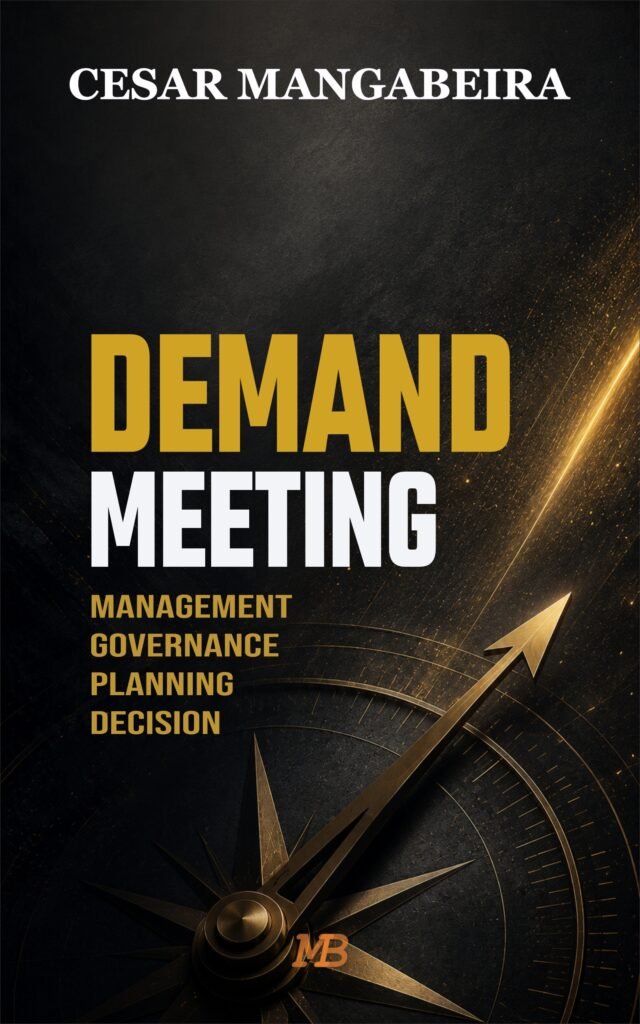
Demand Meeting: Management, Governance, Planning, Decision
Sinopse
Companies invest millions in inventory, production, procurement, and distribution. A significant share of these decisions originates at a single point in the planning cycle: the Demand Review Meeting. When managed with structure, discipline, and cross-functional collaboration, it improves decision quality, strengthens organizational alignment, and creates the conditions to enhance the performance of the entire supply chain. Mastering the management of this meeting provides a competitive advantage capable of generating tangible value for both professionals and organizations.
This book presents a comprehensive approach to transforming the Demand Review Meeting into a strategic management process. You will discover how to structure every stage of the planning cycle, from foundational principles and governance to decision follow-up, continuous improvement, and the evolution of organizational maturity. Throughout the book, you will see that the meeting becomes far more than a recurring event. It becomes a central element in building consensus demand, integrating business functions, and improving the quality of demand planning.
Each chapter has been designed to strengthen your ability to analyze complex situations, lead productive discussions, organize meaningful information, and support higher-quality decisions. Rather than presenting isolated concepts, the book brings together practical methods, proven approaches, and management models that can be adapted to organizations of different sizes and levels of maturity. The knowledge presented demonstrates how incremental improvements in meeting management can generate significant gains in demand planning and organizational performance.
Throughout the book, you will learn how to:
• establish effective governance for the Demand Review Meeting;
• organize information that supports higher-quality decisions;
• conduct meetings that are more productive and results-oriented;
• build consensus demand across different business functions;
• monitor actions and decisions throughout the planning cycle;
• use performance indicators to improve meeting management;
• develop a process of continuous improvement and organizational maturity.
The book integrates the core concepts of Demand Planning and S&OP from a distinctive perspective: the management of the Demand Review Meeting itself. Every topic demonstrates how this process directly influences the quality of decisions related to sales, operations, inventory, production, procurement, and customer service. You will understand that superior decisions are built through meetings conducted with sound methods, reliable information, cross-functional participation, and disciplined execution.
If you are involved in demand planning, demand forecasting, integrated decision-making, or the management of the S&OP process, this book will provide you with a comprehensive guide to transforming Demand Review Meeting Management into a continuous source of value creation for your organization.
Every planning cycle represents an opportunity to make better decisions. This book shows you how to transform that opportunity into a consistent management process capable of improving decision quality, strengthening cross-functional collaboration, and continuously enhancing demand management performance.
Disponível nas principais livrarias e plataformas digitais.
Sumário
1 Fundamentals of Demand Review Meeting Management
1.1 What Is Demand Review Meeting Management?
1.2 Purpose of the Demand Review Meeting
1.3 Role of the Demand Meeting in the S&OP Process
1.4 Scope of the Demand Meeting
1.5 Benefits of Demand Meeting Management
1.6 Principles of Demand Meeting Management
2 Demand Review Governance
2.1 Meeting Owner
2.2 Roles and Responsibilities
2.3 Composition of the Meeting
2.4 Specialists and Guests
2.5 Participation Criteria
2.6 2.6. Cross-Functional Collaboration
2.7 Meeting Governance Model
3 Demand Review Meeting Planning
3.1 Meeting Planning
3.2 Meeting Calendar
3.3 Meeting Frequency
3.4 Meeting Agenda
3.5 Meeting Invitation
3.6 3.6. Meeting Preparation
3.7 Extraordinary Meeting Invitation
4 Data for the Demand Review Meeting
4.1 Demand History
4.2 Statistical Forecast
4.3 Assumptions
4.4 Market Intelligence
4.5 Events Influencing Demand
4.6 Performance Indicators
4.7 Additional Information
5 Information Management for the Demand Review Meeting
5.1 Information Collection
5.2 Validation of Information
5.3 Information Consolidation
5.4 Exception Management
5.5 Information Distribution
5.6 Readiness for the Meeting
6 Execution of the Demand Review
6.1 Opening the Meeting
6.2 Presentation of Information
6.3 Demand Discussion
6.4 Managing Disagreements
6.5 Building Consensus
6.6 Formalization of Decisions
6.7 Closing the Meeting
7 Demand Review Meeting Infrastructure
7.1 Meeting Environment
7.2 Information Systems
7.3 Dashboards
7.4 Supporting Documents
7.5 Communication Resources
7.6 Communication Resources
7.7 Resources for Virtual Meetings
8 Outputs of the Demand Review Meeting
8.1 Meeting Decisions
8.2 Consensus Demand
8.3 Validated Assumptions
8.4 Action Plan
8.5 Meeting Record
8.6 Information for the Supply Review
9 Management of Demand Review Outputs
9.1 Communication of Decisions
9.2 Distribution of Outputs
9.3 Responsibility for Outputs
9.4 Information Traceability
9.5 Action Plan Monitoring
9.6 Forwarding to the Supply Meeting
10 Demand Review Meeting Indicators
10.1 The Role of Indicators in the Demand Review Meeting
10.2 MAD — Mean Absolute Deviation
10.3 MAPE — Mean Absolute Percentage Error
10.4 FA — Forecast Accuracy
10.5 FB — Forecast Bias
10.6 TS — Tracking Signal
10.7 FVA — Forecast Value Added
10.8 Comparison and Selection of Indicators
11 Follow-up of the Demand Review Meeting
11.1 Action Monitoring
11.2 Decision Follow-up
11.3 Pending Issue Management
11.4 Review of Assumptions
11.5 Preparing the Next Planning Cycle
11.6 Closing the Planning Cycle
12 Improving Demand Review Meeting Management
12.1 Evaluating Meeting Effectiveness
12.2 Lessons Learned
12.3 Standardizing Practices
12.4 Continuous Improvement of the Meeting
12.5 Meeting Performance Indicators
12.6 Maturity of Demand Review Meeting Management
Disponível nas principais livrarias e plataformas digitais.